
A Gentle Guide from Dr. Nicole
If you are preparing to say goodbye to your pet, one of the hardest parts may be fear of the unknown and feeling worried about what to expect. Families often ask me questions like:
Will my pet be scared?
Will it hurt?
How long will the appointment take?
Can I hold them?
What will I see when they pass?
These are difficult questions to ask, but knowing what to expect can take away some of the fear surrounding the unknown.
I often tell families that, when the time comes, their pet’s last moments can be as simple and comforting as eating a good treat and taking a nice nap.
That is the kind of peaceful experience we hope to create: your pet feeling safe, comfortable, and surrounded by the people they trust.
I founded Serene Passages around this simple belief. Today, I’m joined by a team of experienced veterinarians who have specialized training in end-of-life care. Every Serene Passages veterinarian is also specifically trained in the processes and techniques we use to minimize fear, pain, and stress during an in-home euthanasia appointment.
While every pet is different and sometimes we need to adjust our approach to their medical condition or individual needs, I want to walk you through what you can generally expect from the moment we arrive until the time we leave.
How long does an in-home euthanasia appointment take?
Most Serene Passages in-home euthanasia appointments take approximately 30–60 minutes.
We do not want your goodbye to feel rushed. The exact timing depends on your pet, their medical condition, how they respond to medication, and what your family needs during the appointment.
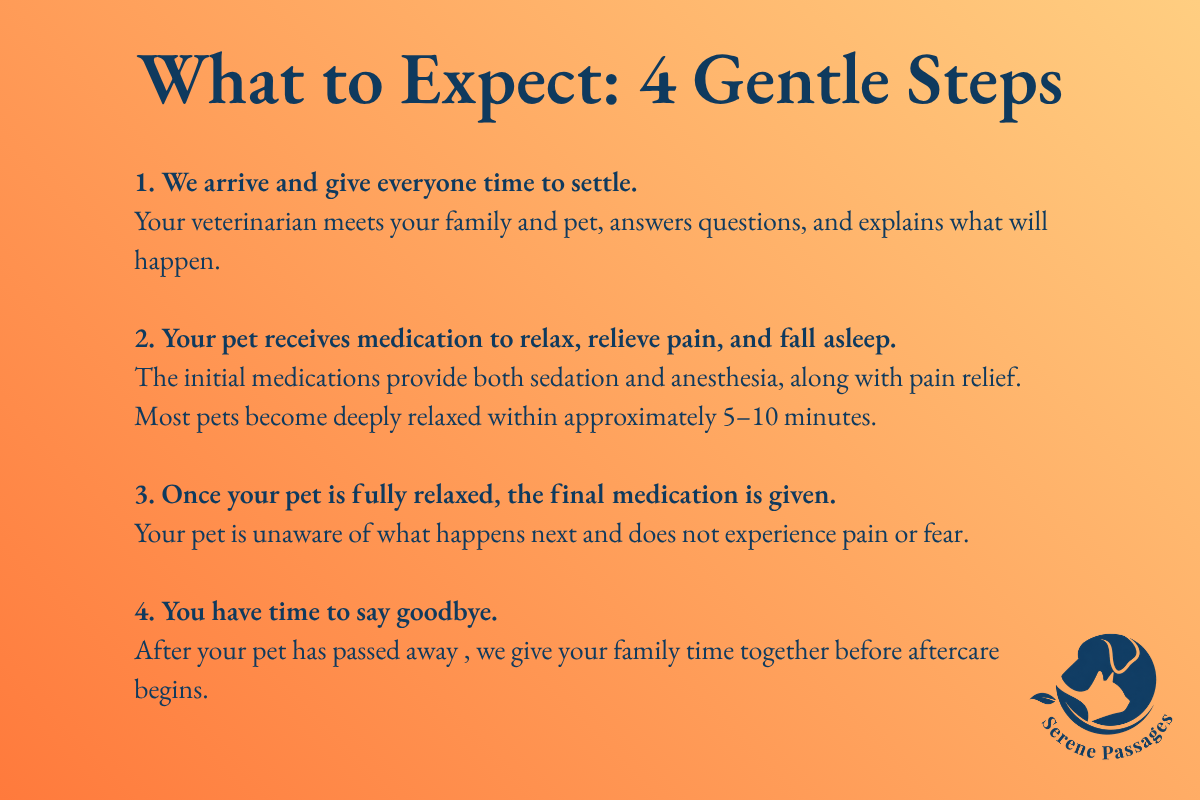
Step 1: Your Veterinarian Arrives and Gives Everyone Time to Settle
We will let you know when your veterinarian is on the way.
When we arrive, we do not immediately begin the medical part of the appointment.
First, we meet you.
We meet your pet.
We allow everyone a little time to become comfortable with one another.
Your veterinarian may also complete any remaining consent details or in-person payment arrangements at this time so those practical matters can be taken care of before your family begins saying goodbye.
Then we talk.
Your veterinarian will explain what is going to happen, answer your questions, and prepare you for some of the normal physical responses you might see during the process.
I believe this conversation is important. Knowing what is normal can keep a new breath sound or small movement, from becoming frightening during a moment you want to remember as peaceful.
Most importantly, we proceed at a pace that takes your pet and your family into consideration.
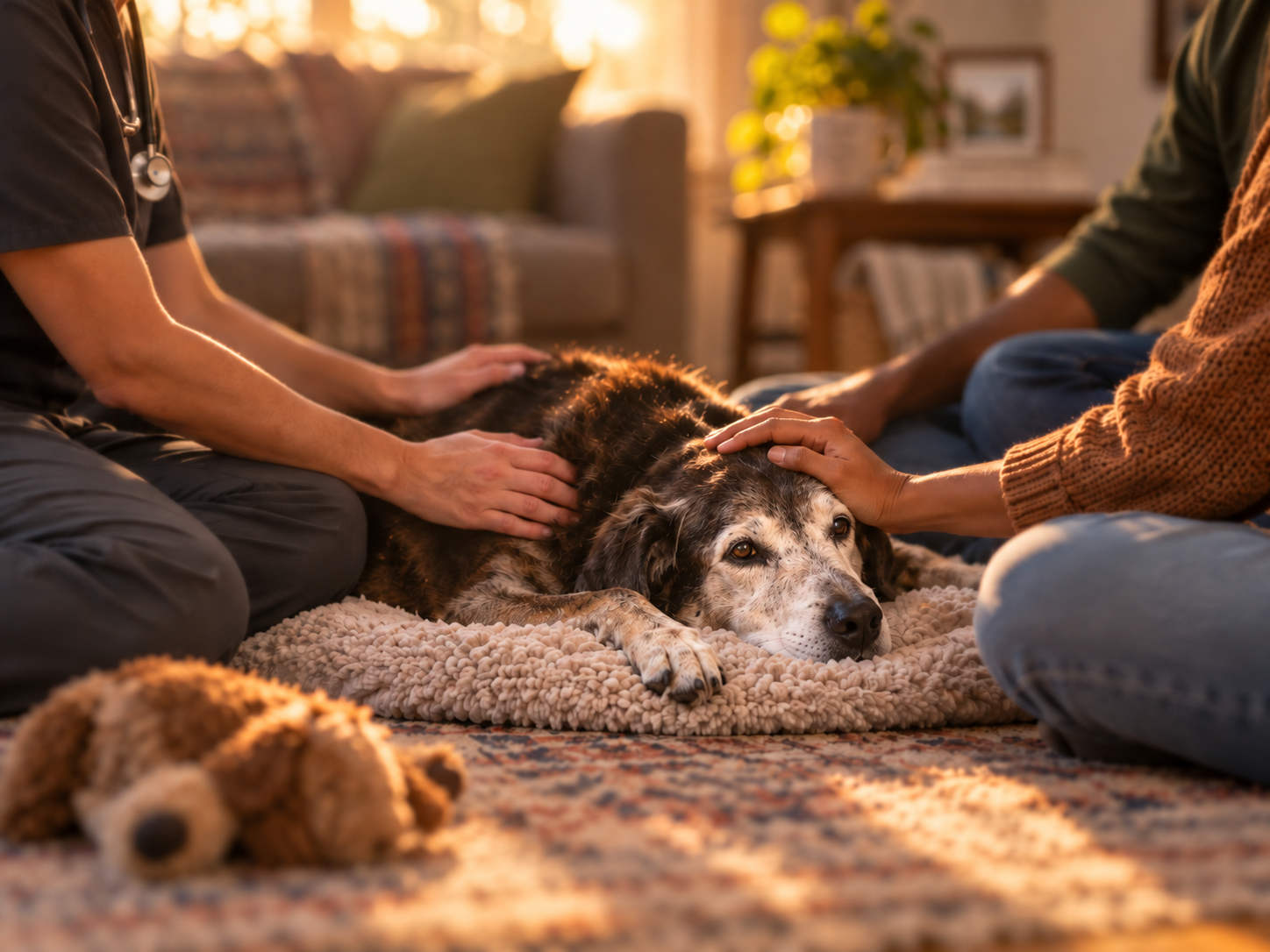
Where Will the Euthanasia Take Place?
One of the benefits of saying goodbye at home is that there usually isn’t one particular place your pet needs to be.
You might choose their favorite bed.
The couch.
Your lap.
A blanket on the living room floor.
A favorite place in the backyard.
A sunny patio.
Or wherever your pet already feels most comfortable.
When conditions allow, you may hold your pet and you can always remain right beside them.
Your veterinarian can help you choose a location that works comfortably and safely for your pet and family.
The main consideration is your pet’s comfort.
For example, if it is extremely hot or cold outside, we may recommend moving indoors. Extreme temperatures can be stressful for sick or elderly pets. Home is the best place to be so there is no need to create the perfect setting.
Choose the place where your pet feels at home.
Step 2: Your Pet Receives Medication to Relax, Relieve Pain, and Fall Asleep
This is one of the most important ways our approach is designed around your pet’s comfort.
Before the euthanasia medication is given, your veterinarian administers initial medications that provide pain relief and allow your pet to become deeply sedated and anesthetized.
If your pet is interested in food, we often use a favorite treat as a distraction while these first medications are given.
For many pets, this is exactly the gentle rhythm we hope for: a good treat and a nice nap.
Most pets become very relaxed over approximately 5–10 minutes.
They will become very sleepy.
Their head will become heavy.
Their body will relax.
They may gradually stop paying attention to what is happening around them as they enter a deeper state of sedation and anesthesia.
Your veterinarian will assess your pet carefully before moving on.
Some pets—because of their size, medical condition, medications, circulation, stress level, or individual response—need additional medication or more time.
That is okay.
We adjust the process to the pet in front of us rather than expecting every pet to respond on exactly the same schedule.
Does in-home pet euthanasia hurt?
Our goal is that your pet is not aware of or distressed by the euthanasia itself.
The initial medications can feel like a small pinch (if you have ever had a shot you know the feeling) and provides pain relief and allows your pet to become deeply sedated and anesthetized. That small pinch brings total comfort. We wait for those medications to take effect before proceeding.
Once your pet is adequately anesthetized, they are unaware of what comes next.
Can I Feed My Pet Before an In-Home Euthanasia Appointment?
Unless your veterinarian has given you different instructions for your pet’s particular medical condition, you can generally feed your pet, provide water and give their regular medications as normal before our visit.
There is no need to withhold a normal meal simply because we are coming.
I do recommend avoiding an unusually large “last meal” immediately before the appointment.
There is a practical reason for this: if your pet still enjoys food, your veterinarian may want to use something especially tasty to distract them while the first medications are given. If they are excited about food and haven’t gorged on snacks before our arrival, then your pet is much more likely to eagerly enjoy those goodies and not notice that small pinch from the first medications.
So by all means, let your pet enjoy the foods they love—just consider saving a favorite treat for when we arrive.
Before we arrive:
-
Give regular medications unless you have been instructed otherwise
-
Feed your pet normally
-
Avoid an unusually large meal immediately beforehand
-
Have a favorite treat available if your pet is still interested in food
-
Choose a comfortable place for your pet to rest
-
Invite the people you want with you
-
Have a favorite blanket, bed, toy, or other comforting item nearby if you wish
There is no need to make the day perfect. Being somewhere familiar, with the people they love, is enough.
Step 3: Once Your Pet Is Fully Relaxed, We Prepare for the Final Medication
Only after your veterinarian is satisfied that your pet is appropriately relaxed and anesthetized do we move to the next step.
In most cases, your veterinarian will place a small IV catheter.
This gives us controlled access for administering the euthanasia medication while your pet is already deeply relaxed and unaware of the procedure.
There are circumstances in which an IV catheter may not be the best approach. A pet’s disease, circulation, body condition, or other medical factors can change what is appropriate.
Your veterinarian may use another method when needed.
This is one of the reasons having an experienced veterinarian present matters: we can adapt the medical technique while keeping the same goal—your pet’s comfort and a peaceful passing.
Step 4: The Euthanasia Medication Is Given
Once your pet is deeply relaxed and your family is ready, your veterinarian will administer the euthanasia medication.
You can remain close.
You may be touching your pet, talking to them, resting your hand on them, or holding them when circumstances allow.
The medication quiets your pet’s brain and allows the signals that control breathing and heart rate to slow and then stop. This is what causes your pet’s body to stop functioning.
Because your pet is already anesthetized, they are not consciously experiencing this process and do not feel fear or pain.
Your veterinarian will remain attentive to your pet throughout the process and will let you know when your pet has passed away.
For many families, this part happens more quietly and serenely than they anticipated.
What Might I See as My Pet Passes?
I believe families deserve an honest answer to this question.
Most pets become very still and peaceful.
But bodies do not always behave exactly the way we imagine they will at the moment of death.
You will notice a change in your pet’s breathing.
There may occasionally be deeper breaths or a breath after a longer pause. Some pets may make a sound or vocalization as air leaves the lungs.
Most pets will have their eyelids partially open since there is no longer muscle energy to close them.
You may notice small muscle twitches or stretches.
These responses can be surprising if you are not expecting them, which is why your veterinarian will talk with you beforehand about what you might see.
The important thing to understand is that these responses do not mean your pet is frightened, hurting, or consciously experiencing distress.
At this stage, your pet has already received anesthetic medication and is not consciously aware of what is happening.
A breath, movement, or sound does not mean your pet is suffering.
Some physical responses can occur as the body shuts down even though your pet is deeply anesthetized and unaware.
Your veterinarian will be beside you and can explain anything you see.
This is also why I encourage families to ask questions—even questions that feel uncomfortable or silly.
Knowing what may happen can make the experience much less frightening.
Can I Hold My Pet During Euthanasia?
Often, yes.
When your pet’s condition and the practical needs of the procedure allow, we want you to be close to them in whatever way feels natural.
For some families, that means holding a small dog or cat.
For others, it means lying beside a large dog on their bed.
You might stroke their head, hold a paw, whisper to them, or simply rest your hand on their soft fur.
There is no correct way to say goodbye.
And if you find that you cannot be present for every part of the process, that is okay. It does not diminish the bond you share with your pet.
Talk with your veterinarian about what you need. We can help you understand your options.
Should Children Be Present?
Children can be present, and for some families that is an important part of saying goodbye.
Whether it is right for your child depends on their age, maturity, relationship with your pet, and your family’s needs.
There is no single right choice.
If your children will be present, I encourage you to prepare them honestly and in age-appropriate language for what will happen.
Our veterinarians can also explain the process and answer questions during the appointment.
Preparing Children for Pet Euthanasia →
Should My Other Pets Be Present?
Usually, I recommend a slightly different approach for other animals in the home.
Other pets may greet the veterinarian initially, but we often recommend that they stay in another room during the medical portion of the appointment.
This gives your veterinarian a more controlled environment and allows us to focus completely on the pet receiving care.
After your pet has passed away , other pets can usually be brought back into the room to say goodbye.
For bonded animals in particular, giving them an opportunity to see and smell their companion after death may help them understand that something has changed rather than simply experiencing their friend disappearing from the home.
Every household is different, though. If another pet is anxious, protective, reactive around visitors, or likely to create stress for you or your pet, we may recommend a different plan.
What Happens Immediately After My Pet Passes Away?
Your veterinarian will confirm that your pet has passed away and let you know gently.
And then we stop.
There is no need to immediately move on to the next thing.
Most families choose to spend a few minutes with their pet afterward. Some need more time.
You may want to hold them.
Talk to them.
Sit quietly.
Cry.
Pray.
Bring another pet in to say goodbye.
Or simply be together as a family.
Your veterinarian can step away and give you privacy.
There is no particular thing you need to say or do.
This is your goodbye.
What Happens to My Pet After In-Home Euthanasia?
You have choices about what happens next.
Depending on your wishes and what is appropriate for your family, aftercare options may include:
Private cremation
Communal cremation
Aquamation
Home burial where legally permitted and appropriate
Cemetery burial
Donation to science when available and eligible
Family-arranged aftercare
Memorial keepsakes such as paw prints or fur clippings
In some circumstances, specialized preservation or taxidermy services
You do not have to choose the same option another family would choose.
Some people want their pet’s ashes returned so they can keep or scatter them.
Others feel strongly that they do not need physical remains.
Some families want a paw print or clipping of fur.
Others prefer photographs and memories.
These are personal choices, and our Care Team can help you understand the options available before your appointment.
Pet Aftercare and Transportation Options →
If Serene Passages is coordinating your pet’s aftercare, we can also arrange transportation.
Depending on your pet’s size, the day, and the arrangements you have selected, your pet may be transported by your veterinarian or by our aftercare specialist.
We handle this transition with care and dignity.
For larger pets, we may occasionally ask a family member to assist with moving your pet safely. If that may be necessary, we will communicate with you.
What If My Pet Is Anxious, Reactive, or Afraid of Visitors?
Please tell our Care Team before the appointment.
This is not something to feel embarrassed about.
Some of the sweetest pets I have met are frightened of visitors, protective of their families, afraid of needles, or very stressed by handling.
Knowing this ahead of time helps us plan.
We may change how we enter the home, where we meet your pet, how much interaction we initially have with them, or what medications are appropriate.
For some pets, additional medication or a specialized plan may be helpful.
Our goal is not to force your pet through a standard sequence.
Our goal is to find the gentlest approach for your pet.
What If Something Doesn’t Happen Exactly as Described Here?
This is important to understand before your appointment.
Every pet is different.
Most appointments follow the general sequence I have described, but medicine is not completely predictable.
A very ill pet may process medication differently.
Poor circulation may affect how quickly medication works.
A frightened pet may need additional sedation.
An IV catheter may not be the best choice for a particular animal.
Something that usually takes five minutes may take longer.
This does not mean something has gone wrong.
Our veterinarians are experienced in end-of-life care and specifically trained in the Serene Passages approach. They can adjust the medications, timing, positioning, and techniques based on what your pet needs.
Sometimes the gentlest thing we can do is simply give them more time.
We follow your pet, not the clock.
Most appointments take approximately 30–60 minutes, and the initial relaxation medication commonly takes about 5–10 minutes to take effect.
Those are guidelines, not fixed timelines. If your pet needs additional medication or more time to become fully relaxed, we give them what they need.
What If I’m Not Sure It’s Time Yet?
You do not need to schedule euthanasia simply because you have started thinking about it.
If you are still wondering whether your pet has enough comfort and enjoyment in their days, start by looking at their quality of life.
Are they comfortable?
Are they eating and drinking?
Can they rest?
Can they move where they need to go?
Are they still interested in the people, places, foods, and routines that matter to them?
And are the comfortable days still outweighing the difficult ones?
You can also speak with your regular veterinarian or ask us about a quality-of-life assessment.
You do not have to make this decision alone.
Why Families Choose In-Home Pet Euthanasia
Being at home allows us to remove many of the things that can make a final veterinary clinic visit stressful.
There is no difficult car ride for a painful or frightened pet.
No waiting room.
No unfamiliar smells or sounds. No bright lights.
Perhaps most importantly, no metal exam table.
No need to ask a frail dog to walk farther than they comfortably can.
No need to coax a frightened cat out of their carrier in an unfamiliar room.
Instead, your pet can be where they know they are comfortable.
They can lie on their bed.
They can be surrounded by familiar smells.
They can hear familiar voices.
They can have their favorite treat if they still want one.
And they can have you.
That is what I want families to understand about in-home pet euthanasia.
It is still a profound loss. Being at home cannot make saying goodbye easy.
But we can work to make the experience gentler.
You Can Ask Us Questions Before You Decide
If you are reading this because an appointment is approaching, I hope knowing what to expect has made the unknown feel a little less frightening.
And if you are reading because you think your pet may be nearing the end of their life but you are not sure what to do next, you are welcome to reach out before you have made a final decision.
Serene Passages provides compassionate in-home end-of-life care throughout the Inland Empire and surrounding desert, high desert, and mountain communities.
Our veterinarians have experience and specialized training in helping pets through this transition. They have also been specifically trained in the Serene Passages processes I have developed to prioritize comfort, minimize fear and pain, adapt to the individual pet, and give families space to say goodbye.
You can ask questions.
You can tell us what you are worried about.
You can tell us about your pet before we arrive.
And when the time comes, we will guide you through what is happening one step at a time.
Your job is simply to love them.
We will help you with the rest.
Ready to learn more?
Learn about our in-home euthanasia services, including how we help pets remain comfortable at home during their final goodbye.
Not ready to schedule? That’s okay.
You can contact our Care Team with questions or request more information without committing to an appointment.
About Dr. Nicole Stanclift
Nicole Stanclift, DVM, is the founder of Serene Passages and an experienced in-home end-of-life veterinarian. Dr. Nicole and the Serene Passages veterinary team provide compassionate in-home euthanasia and end-of-life care for pets and the families who love them throughout the Inland Empire, desert, high desert, and mountain communities.