
A Compassionate Guide from Dr. Nicole
“How will I know when it’s time?”
Of all the questions families ask me about the end of a pet’s life, this may be the most challenging.
I wish there was one unmistakable sign I could tell you to look for, but there usually isn’t just one.
More often, families are watching a collection of small changes. Their dog is still eating, but needs help getting up. Their cat still purrs beside them, but no longer grooms herself or jumps onto the bed. There may still be good moments, sometimes very good moments, mixed with increasingly difficult ones.
That uncertainty can be deeply uncomfortable.
As a veterinarian who has spent many years helping thousands of families through end-of-life decisions, I want you to know that you do not have to wait for one clear moment to tell you what to do.
Instead, we can look at your pet’s quality of life as a whole: their comfort, function, dignity, interests, and ability to enjoy the things that make life feel like their life.
And if you need help making sense of what you are seeing, you do not have to figure it out alone.
The short answer:
It may be time to consider euthanasia when your pet can no longer be kept reasonably comfortable, when important parts of daily life have become persistently difficult, or when difficult days are beginning to outweigh the days in which they can comfortably enjoy being themselves.
What Does “Quality of Life” Mean for a Pet?
Quality of life is not simply whether your pet is alive, eating, or able to stand.
It is a way of looking at your pet’s physical and emotional well-being as a whole.
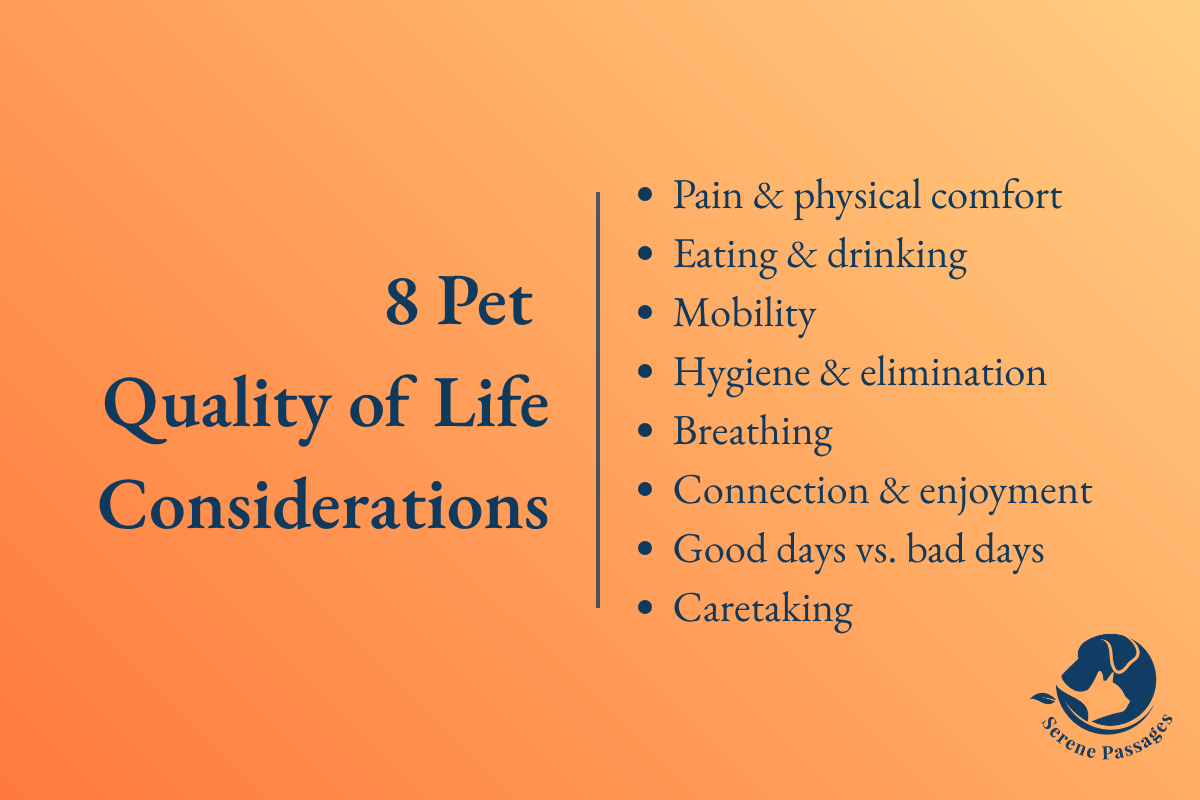
When I talk with a family about quality of life, I usually consider several areas:
- Pain and physical comfort: Is pain well controlled? Can your pet rest comfortably? Are they panting, trembling, restless, tense, or struggling to find a comfortable position?
- Eating and drinking: Are they eating willingly, or does every meal require significant coaxing? Are nausea, dehydration, or weight loss becoming concerns?
- Mobility: Can they get up, walk, reach their food and water, go outside, or get into the litter box without significant distress?
- Hygiene and elimination: Can they urinate and defecate comfortably? Can they remain reasonably clean and dry?
- Breathing: Can they breathe comfortably while resting?
- Connection and enjoyment: Do they still respond to you and their surroundings? Are there parts of the day they genuinely seem to enjoy?
- Good days versus difficult days: Looking across a week or several weeks, which kind of day is becoming more common?
- Caretaking considerations: Is maintaining care becoming a major stressor for you or someone in the family? How does the additional care of your sick pet impact other important activities, such as sleep, or your social life? Can you afford the costs of maintaining your pet’s care at a level that allows them to be comfortable?
A quality-of-life scale for pets can also help you look at these changes more objectively.
But no score can make the decision for you.
A quality-of-life scale is a tool for helping you notice patterns and start a conversation, it’s not a judgement about what you are supposed to do.

Signs of Declining Quality of Life in Dogs
Dogs often show us changes through their everyday routines.
You may notice that your dog takes longer to stand, slips on the floor, struggles with stairs, or no longer wants to take the walks they once loved.
Some dogs begin panting or pacing when they are uncomfortable. Others become quieter and sleep much more.
Changes I ask families to pay particular attention to include:
- Difficulty getting up, standing, walking, or going outside
- Falling or repeatedly slipping
- Persistent panting, restlessness, trembling, or difficulty settling
- Loss of interest in walks, toys, food, family interaction, or favorite routines
- Significant loss of appetite or weight
- Frequent vomiting, diarrhea, or accidents that are distressing to your pet
- Increasing confusion, anxiety, nighttime pacing, or changes in sleep
- Pain that is becoming difficult to control
- Increasing difficulty breathing
- Repeated medical crises or emergency visits
One change by itself does not necessarily mean it is time to say goodbye.
What matters is the overall pattern, how severe the changes are, and whether we can still manage them in a way that gives your dog meaningful comfort.
Signs of Declining Quality of Life in Cats
Cats can be especially difficult to read.
They are remarkably good at adapting and concealing discomfort. A cat may not cry or visibly show pain, even when their world has become much smaller.
For cats, I often ask families to think about changes in ordinary behavior.
Is your cat still grooming?
Can they comfortably get into their litter box?
Are they jumping onto the couch or bed, or have they gradually stopped?
Are they sleeping in familiar places, or hiding somewhere unusual?
Are they interacting with you in the way they normally would?
Changes that deserve attention can include:
- Hiding or withdrawing more than usual
- Stopping or reducing grooming
- A greasy, matted, or unkempt coat
- Difficulty jumping, climbing, walking, or getting into the litter box
- Urinating or defecating (peeing or pooping) outside the litter box, when this is unusual for them
- Decreased appetite or significant weight loss
- Sleeping much more or becoming less responsive to family activity
- Changes in posture or difficulty getting comfortable
- Irritability or avoiding being touched, when they had previously not shown this
- Changes in breathing
- Losing interest in affection, favorite sleeping places, food, or familiar routines
With cats especially, subtle changes matter.
You know what is normal for your cat. A collection of small differences can tell us much more than one dramatic symptom.

Look at the Whole Day, Not Just One Moment
When you love your pet, it is very natural to hold onto the good moments.
And those moments matter.
But one happy moment does not always tell us what the rest of your pet’s day feels like.
Your dog may still wag when you walk into the room but struggle to get comfortable for much of the night.
Your cat may still eat a favorite treat but spend most of the day withdrawn or unable to move comfortably.
When you are trying to understand quality of life, I encourage you to zoom out.
Ask yourself:
- What does most of my pet’s day look like?
- How much effort does it take for them to do basic things?
- Are they comfortable when they are resting?
- Are they still choosing to participate in the things they enjoy?
- Is their world becoming smaller?
- Are we managing their symptoms, or are their symptoms increasingly managing the day?
A helpful question to ask:
Is there still enough comfort and enjoyment in my pet’s day to outweigh what their body is asking them to endure?
Try Tracking Good Days and Difficult Days
One of the simplest things I recommend is putting a mark on the calendar each evening.
Was today a good day, a difficult day, or somewhere in between?
You can also write down two or three things that define a good day for your pet.
For one dog, a good day might mean eating breakfast, walking to the mailbox, and sleeping comfortably beside their person.
For another, it might mean taking a few bites of chicken and enjoying some quiet time in the backyard.
For a cat, it might mean eating voluntarily, grooming, sitting in a sunny window, and coming over for affection.
The activity itself does not need to be impressive.
What matters is whether your pet is still able to experience the small pleasures that have always made their life their own.
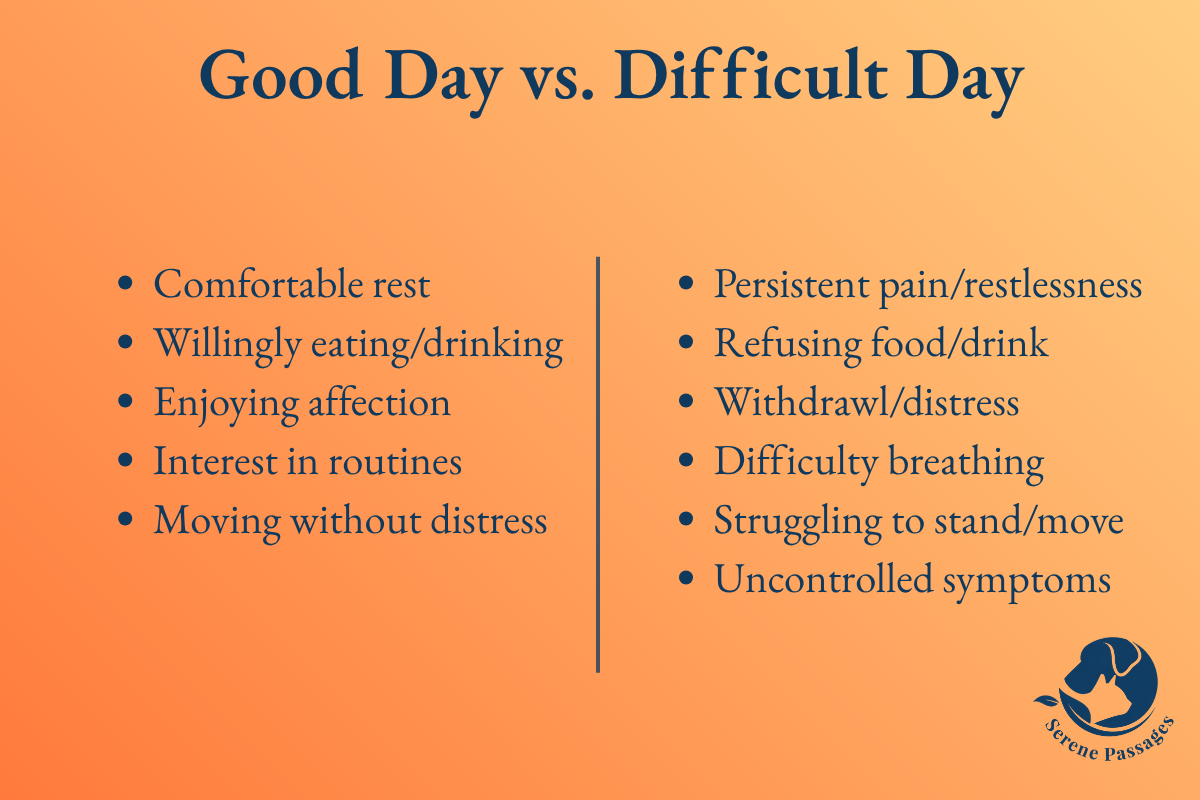
Keeping track can be especially helpful because increases in caregiving happen gradually.
When you are with your pet every day—and when you love them deeply—it can be surprisingly difficult to recognize how much has changed.
You Do Not Have to Wait for a Crisis
This is the part of the conversation I most want families to hear.
Many people believe they will eventually receive a completely clear sign.
They imagine their pet will stop eating altogether, become unable to stand, or somehow look at them in a way that says, “I’m ready.”
Sometimes that happens.
Often, it doesn’t.
Instead, a pet who has been slowly declining may experience a crisis: severe pain, difficulty breathing, collapse, uncontrolled symptoms, or an emergency in the middle of the night.
A family who desperately wanted to give their pet a peaceful goodbye can suddenly find themselves rushing to an emergency hospital.
If we already know that a disease is progressing and our ability to maintain comfort is becoming limited, we do not have to wait until suffering becomes extreme.
There can still be a tail wag.
There can still be a purr.
There can still be a favorite treat.
A peaceful goodbye does not have to happen only after every good thing is gone.
Choosing a peaceful goodbye before a predictable crisis is not “giving up on them.”
When a family chooses euthanasia while their pet can still rest in a favorite bed, receive affection, or enjoy a special treat, but before severe suffering occurs, I see a family protecting someone they love.
Choosing comfort and peace can be one final act of love and caregiving.
“But My Pet Is Still Eating.”
This is one of the things I hear most often.
Eating is important, but it is only one part of quality of life.
Some pets continue eating despite significant pain, mobility problems, breathing difficulty, cognitive decline, or advanced disease.
Other pets temporarily lose their appetite because of a problem that can still be treated.
So I would never use appetite alone to decide whether it is time.
Instead, I ask:
What does the rest of the day look like?
If your pet eats breakfast but spends the remaining hours uncomfortable, frightened, unable to move easily, or disengaged from everything around them, eating does not necessarily mean their overall quality of life is good.
“But My Pet Still Has Good Days.”
Good days matter too.
The question is whether they remain frequent enough, and comfortable enough, to outweigh their difficult ones.
I also encourage families to look at the quality of those good days.
Is your pet genuinely comfortable and engaged?
Or are there brief bright moments surrounded by long periods of discomfort?
There is no required ratio and no mathematical formula.
You are looking for trends.
If your pet’s world is steadily shrinking and the things that once made life enjoyable are disappearing, that deserves attention even if there are still occasional wonderful moments.
What If I’m Making the Decision Too Soon?
Almost every loving pet owner worries about this.
We naturally want more time with the animals we love.
The difficulty is that waiting for absolute certainty can sometimes mean waiting until our pet has very little comfort left.
When I help families think through this decision, I am not looking for a reason to euthanize their pet.
I am helping them understand the balance between more time, and the experience their pet is having during that time.
Sometimes continued treatment is absolutely appropriate.
Sometimes we can make meaningful changes that improve comfort.
And sometimes, despite all the love and care a family is giving, their body is no longer able to offer enough comfort.
There is an important difference between ending a life that still feels good to your pet and preventing a life-limiting illness from causing suffering that we can see coming.
That distinction is where veterinary guidance can be especially helpful.
What If I’m Still Not Sure?
You do not need to be certain before asking for help.
In fact, I would much rather talk with a family while they are still wondering than meet them for the first time in the middle of a crisis.
A quality-of-life assessment at home gives us an opportunity to look at your pet’s medical condition, comfort, daily activities, environment, and the changes you have been noticing.
Sometimes that conversation leads to euthanasia.
Sometimes it does not.
There may still be ways to improve comfort through pain management, medications, changes to your pet’s environment, hospice or palliative care, or support from your primary veterinarian.
As a veterinarian, I am not trying to make the decision for you.
My role is to help you understand what your pet may be experiencing, what options remain, and what changes might tell us that the balance has shifted.
You do not need to wait until you have made a final decision to contact us.
If you are unsure about your pet’s quality of life, our veterinary team can help you understand your options.
When Should I Seek Emergency Veterinary Care?
A quality-of-life discussion should never delay emergency treatment when a pet is in acute distress.
If your dog or cat is struggling to breathe, experiencing severe or uncontrolled pain, repeatedly collapsing, having prolonged or repeated seizures, experiencing uncontrolled bleeding, or showing another sudden and serious change, please contact an emergency veterinarian immediately.
Once your pet is stabilized, or if continued treatment is no longer consistent with your goals, you can then talk with your veterinarian about what comes next.
Sometimes after an emergency event, we have families that call for our assistance just so they can bring their pet home one last time. They might spend a few hours or a few days together at home before saying goodbye. Often the important thing is that the euthanasia happens in a comfortable place.
What Does a Serene Passage at Home Look Like?
For many pets, home is the place where they feel safest.
There is no car ride, unfamiliar exam room, bright hospital environment, or need to spend their final moments somewhere they do not love.
During an in-home euthanasia appointment, families can choose the place that feels right: a favorite bed, the couch, the backyard, a sunny patio, or simply your arms.
You can learn more about what to expect during an in-home euthanasia appointment before making any decisions.
Knowing what the process involves often helps reduce some of the fear surrounding it.
And when the time does come, our focus is on keeping your pet comfortable, peaceful, and surrounded by the people they love.
How Will I Know I Made the Right Decision?
I wish I could promise that making a compassionate decision would make it feel easy.
Some people feel a sense of relief from the decision, and other times it takes more time before you feel at peace with the decision.
Love and grief can happen along with certainty.
They can also exist next to doubt.
You may wonder whether you acted too soon.
You may wonder whether you should have had one more day.
Those questions are a very human part of loving someone whose life you were responsible for protecting.
When I help a family think through this decision, I often come back to one question:
What choice asks the least of your pet and cares for them best?
Sometimes continuing treatment is the right answer.
Sometimes giving your pet another comfortable day is the right answer.
And sometimes we reach a point when extending time also means extending discomfort, fear, or suffering.
At that point, choosing a peaceful death is choosing love for them.
But it means your side of the love carries the harder part.
You Don’t Have to Decide This Alone
If you are reading this because you are worried about your dog or cat, I know how heavy this decision can feel.
You do not have to wait until you are completely sure before reaching out.
You can start with our quality-of-life resources for dogs and cats, talk with your regular veterinarian, or contact us about an in-home quality-of-life assessment.
Serene Passages supports families throughout the Inland Empire and surrounding desert, high desert, and mountain communities, including areas throughout the Coachella Valley, Victor Valley, San Bernardino Mountains, Redlands, Riverside, San Bernardino, and surrounding communities.
We understand that access to peaceful end-of-life care can be especially important for families living farther from specialty veterinary hospitals or navigating a long drive with a pet who is frail, painful, anxious, or nearing the end of life.
If the time has come, or if you simply need help understanding whether it has, you can request an appointment or ask our locally-based care team a question.
We will help you look at the whole picture, answer your questions, and understand the choices available to you.
Your pet will be treated gently and with dignity.
And whatever the next step may be, we will help you choose it with compassion.
– Nicole Stanclift, DVM
About Dr. Nicole Stanclift
Nicole Stanclift, DVM, is the founder of Serene Passages and an experienced in-home end-of-life veterinarian. Dr. Nicole and the Serene Passages veterinary team provide compassionate in-home euthanasia and end-of-life care for pets and the families who love them throughout the Inland Empire, desert, high desert, and mountain communities.